It’s One of the Most Complex Plumbing Projects in Commercial Construction.
And We’ve Done It Many Times.
A car wash looks simple from the outside. You pull in, water and soap do their thing, you drive out clean. What most people don’t see is the mechanical complexity running underneath and behind that experience — a web of high-pressure water systems, chemical delivery lines, water treatment equipment, underground infrastructure, drainage systems, and in a climate like Northeast Ohio’s, an entire separate layer of engineering dedicated to keeping it all from freezing solid in January.
JEM Plumbing’s commercial division has designed and installed the plumbing systems for multiple car wash facilities across the region. It’s some of the most technically demanding work we do — and we’re good at it. Here’s what actually goes into it.
One Contractor for the Whole Scope
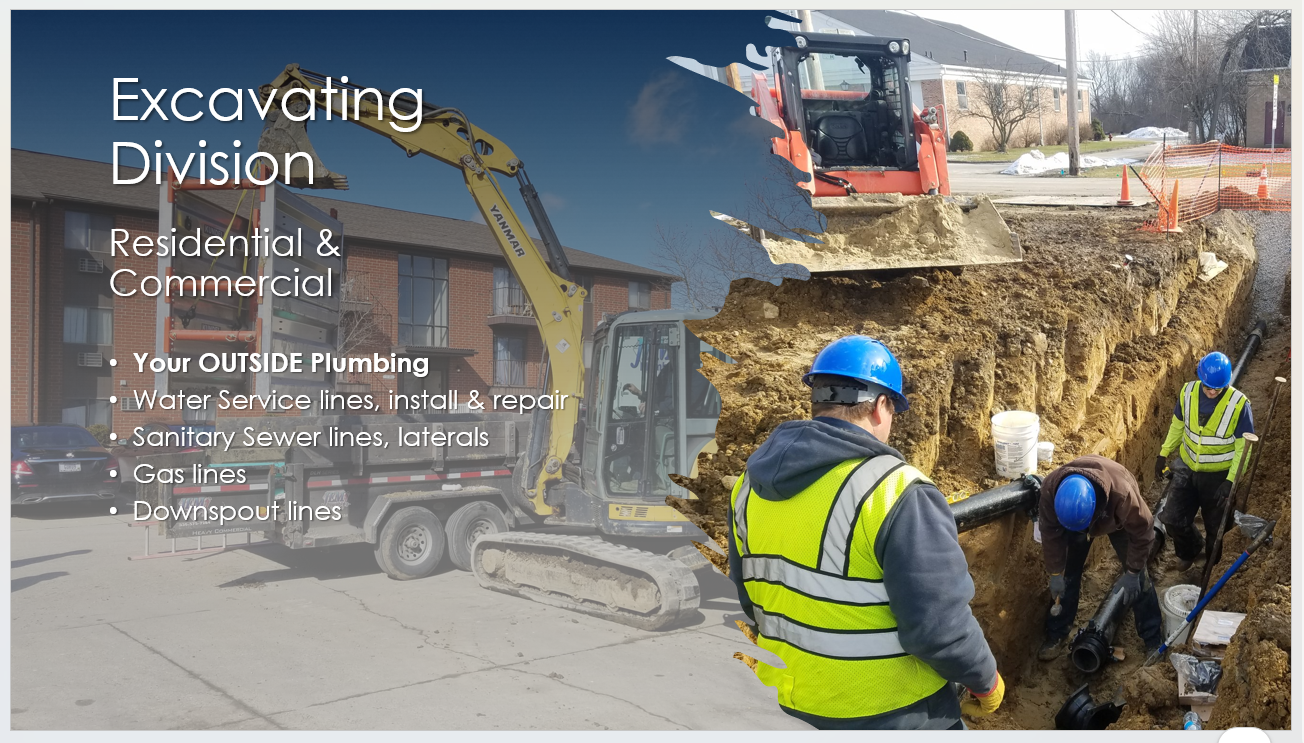
Car wash plumbing involves underground utility work, concrete-embedded systems, mechanical room installation, bay plumbing, water treatment, chemical systems, hydronic heating, and freeze protection engineering — all in a single project. Many of these elements require coordination with the concrete contractor, the equipment supplier, and the building trades. JEM Plumbing handles the full plumbing scope in-house, including our own excavation equipment for the underground work. That single-source accountability keeps the project moving, eliminates finger-pointing between contractors, and ensures that every system is designed to work with every other system — because they were all installed by the same team.
Phase One — Underground: Before the Building Goes Up
Everything starts underground, and getting this phase right is the foundation — literally — for everything that follows.
Site Water Service and Sizing
A commercial car wash is an extremely high-volume water user. Depending on the type of facility — self-serve bays, an in-bay automatic, or a full tunnel wash — the daily water demand can reach tens of thousands of gallons. The water service coming into the building has to be sized to meet peak demand without pressure drop, which means we’re working with large-diameter commercial service lines and coordinating directly with the municipal water authority on tap size, meter sizing, and service pressure requirements.
Get this wrong and the whole facility underperforms from day one. We size it right the first time.
Underground Drain Infrastructure
Every gallon of water that goes into a car wash has to come back out — carrying with it soap, wax, road grime, oil, dirt, and chemical residue from the wash process. The underground drain system has to be designed to handle that volume at peak operation, slope correctly to maintain flow, and connect properly to the oil and sand separator system before discharge reaches the municipal sewer.
In a multi-bay facility, this means a network of trench drains running through each bay, all sloped and manifolded to a central collection point. The trench drains themselves are heavy-duty commercial units built to handle vehicle traffic above them and constant water flow below. Every connection, every slope, and every cleanout point is planned before a single yard of concrete is poured — because once the slab goes down, there’s no fixing it.
Oil, Sand, and Grease Separators
Car washes are required to pre-treat their wastewater before it enters the municipal sewer system. Road grime, motor oil, fuel residue, and particulates all come off vehicles during the wash process and travel into the drain system. An oil and sand separator — sometimes called a grit trap — is required by code and installed underground as part of the initial infrastructure. We size these units based on the facility’s projected water volume and local municipal discharge requirements, and we install them correctly so the operator stays in compliance from the day they open.
Reclaim System Underground Connections
Most modern car washes incorporate a water reclaim system — collecting, treating, and recycling wash water to dramatically reduce fresh water consumption. A traditional car wash system uses up to 80 gallons of water per wash, but a properly optimized reclaim system can reduce average freshwater use to around 30 to 35 gallons per wash. The underground infrastructure for a reclaim system includes collection tanks, transfer lines, and return plumbing that all needs to be planned and installed before the slab is poured. Underground tanks for reclaim water are substantial structures that require careful placement, proper access provisions, and correct connection to both the drain collection system and the pump room.


Phase Two — The Mechanical Room: The Brain of the Operation
If the underground is the foundation, the mechanical room is the heart. This is where every water system in the facility originates and returns, and it’s where the real complexity of a car wash becomes clear.
High-Pressure Pump Systems
Car wash equipment operates on high-pressure water — not the modest pressure of a household faucet but serious commercial pump pressure capable of blasting road grime, brake dust, and salt off a vehicle in seconds. We install commercial high-pressure pump systems sized for the number of bays or tunnel length, the types of equipment in use, and the peak demand the facility needs to serve. These systems require precise plumbing — correct supply line sizing, properly rated fittings, pressure relief provisions, and careful manifolding so every bay or tunnel zone gets consistent, correct pressure.
Water Softeners
Stark County and Summit County water is hard — carrying calcium, magnesium, and dissolved minerals that cause scaling, spotting, and premature equipment wear. Hard water running through a car wash will foul pump seals, clog nozzles, leave mineral deposits on vehicles, and shorten the life of expensive wash equipment. Every car wash we plumb includes a properly sized commercial water softener — or in many cases dual-tank systems that provide continuous soft water without interruption even during regeneration cycles.
Reverse Osmosis — Spot-Free Rinse Systems
The final rinse in a quality car wash — the one that leaves vehicles genuinely spot-free — requires water that’s been purified to near laboratory-grade standards. Regular tap water, even after softening, contains dissolved solids that leave spots when they dry on a vehicle’s surface. A reverse osmosis system forces water through a semipermeable membrane that removes over 99% of dissolved solids, bringing total dissolved solids below 10 parts per million — invisible when it dries. We install the complete RO system including pre-treatment sediment and carbon filtration to protect the membranes, the high-pressure RO pump and membrane housings, a storage tank sized for the facility’s daily volume, and a repressurization pump to deliver spot-free water to the wash bay at the right pressure and flow rate.
Chemical Injection and Delivery Lines
A modern car wash applies multiple chemical products during a single wash cycle — presoak, soap, tire cleaner, wheel brightener, tri-foam conditioner, clear coat protectant, and spot-free rinse, to name the most common. Each of those chemicals has its own supply tank, its own metered injection system, and its own dedicated plumbing line running to specific application points in the bay or tunnel. Routing, labeling, and correctly connecting those chemical lines — using materials that are chemically compatible with each product — is detailed work that requires experience with car wash systems specifically. A wrong material choice or a mis-routed line affects wash quality and can damage equipment.
Reclaim Water Treatment and Return
The reclaim system in the mechanical room is where collected wash water gets treated and recycled back into the wash process. This typically involves a series of treatment stages — settling tanks where heavy solids drop out by gravity, filtration systems that remove finer particles, and in more advanced systems, biological treatment, activated carbon filtration, or UV disinfection that neutralizes bacteria and odor. The treated reclaim water goes back into the system for presoak, pre-rinse, and other wash functions where water quality doesn’t need to be as high as the final rinse. We plumb the full reclaim loop — collection to treatment to return storage to delivery — as an integrated part of the overall water system.
Boiler and Water Heating
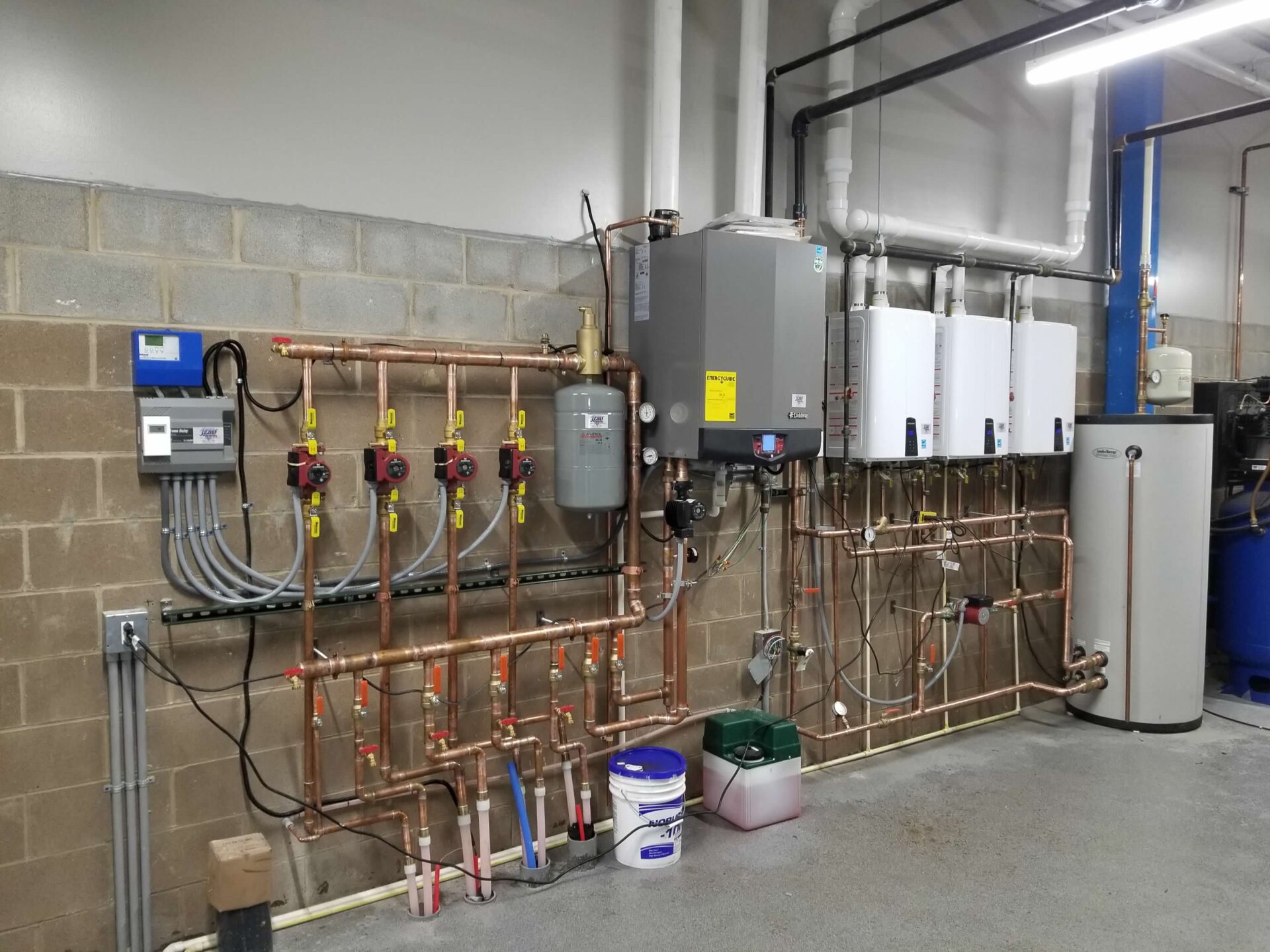
Car wash equipment needs hot water — both for wash effectiveness and, critically in northern Ohio, to keep the entire system functional in cold weather. A commercial boiler sized for the facility’s hot water demand is a central component of every cold-climate car wash we install. The boiler feeds not only the wash water heating system but also the in-floor heating system in the bays — one of the most critical freeze protection elements in the entire building.
Phase Three — The Bays: Where It All Comes Together
The mechanical room supplies everything. The bays are where it’s delivered — and the plumbing work in the bays is both precise and extensive.
Trench Drains and Floor Sloping
Every wash bay floor is sloped to trench drains that run the length or width of the bay. These drains have to be positioned correctly, set at the right elevation relative to the finished concrete, and connected properly to the underground collection system. A badly placed or improperly sloped trench drain creates standing water on the bay floor — which in a cold-climate operation means ice, which means a liability risk and a facility that can’t safely operate in winter.
Supply Manifolds and Bay Plumbing
Each bay gets a supply manifold bringing hot and cold water, chemical lines, and in self-serve bays, high-pressure wash water and foam brush supply. The supply runs inside a protected trough or enclosure — typically a heated trough in cold-climate facilities — that keeps the lines above freezing even when outside temperatures drop significantly. Connections, unions, and shutoff points are planned at every bay so individual bays can be isolated for service without shutting down the whole facility.
Overhead and In-Wall Plumbing
In-bay automatics and tunnel washes have overhead plumbing supplying wash arches, rinse booms, foam applicators, and air dryers. Getting overhead supply lines correctly sized, properly supported, and cleanly routed is work that shows — it affects how the equipment performs, how easy the facility is to maintain, and what the building looks like to a customer pulling through.
Phase Four — The Cold Climate Challenge
This is where Northeast Ohio car wash plumbing separates itself from warmer-climate work — and where experience makes all the difference. A car wash that isn’t properly designed for winter operation in Ohio will freeze, damage equipment, create ice hazards for customers, and lose revenue during the cold months when car washes are actually busiest.
In-Floor Radiant Heat — The Most Critical System
The single most important freeze protection element in a cold-climate car wash is radiant heat embedded in the concrete floor of every bay. Hot water runs through tubing cast into the slab, keeping the concrete surface above freezing even when doors are open and outside air is pouring in. This does two things: it prevents ice from forming on bay floors — a major liability if a customer slips — and it provides enough ambient warmth in the bay to protect the lower portion of the supply plumbing and equipment from freezing during operation.
We design and install hydronic in-floor systems in car wash facilities as part of the full plumbing scope — the same expertise we bring to commercial radiant heating installations in other building types. The boiler in the mechanical room feeds the floor loops, and the system is thermostatically controlled so it runs when it’s needed and backs off when it isn’t, keeping operating costs in check.
The Weep System — Keeping Lines Moving
Even with floor heat in the bays, the supply lines — particularly in self-serve facilities where bays may sit idle for hours in cold weather — are vulnerable to freezing when water isn’t moving through them. A weep system is a thermostatically controlled system that delivers a continuous low-pressure trickle of water through the supply hoses and nozzles in each bay whenever the temperature drops below a set threshold. Moving water doesn’t freeze. The weep system keeps water circulating through the lines at all times in cold weather, preventing freeze-up even in extended cold snaps. Most modern weep systems are thermostatically controlled and increase their flow rate as temperatures drop — trickling at 32°F, flowing more steadily at 25°F, and running continuously below 15°F.
We plumb the weep system as part of the initial installation — connecting it to the water supply, routing it correctly to every bay, and integrating the thermostat controls so the system works automatically without requiring an operator to manually intervene every cold night.
Heated Troughs for Supply Lines
All of the chemical and water supply lines running to the bays travel through a protected trough. In a properly designed cold-climate car wash, that trough is heated — either with hydronic heat loops tied to the boiler, or with electric heat cable — so the lines inside never reach freezing temperature regardless of how cold it gets outside. This is particularly important for chemical lines, which in many cases cannot be allowed to freeze without damaging the chemical delivery equipment or causing chemical separation in the lines.
Pipe Insulation and Heat Trace
Any supply line that runs through an area that isn’t maintained above freezing — exposed sections, runs through unheated spaces, lines transitioning from underground to above grade — gets properly insulated and in critical locations, heat trace cable. Heat trace is a self-regulating electric cable that wraps around or runs alongside a pipe and adds just enough heat to keep the line above freezing, consuming more energy as the temperature drops and less as it rises. We specify and install heat trace on every section of car wash plumbing that warrants it, which in a Northeast Ohio winter is anywhere a line could see temperatures below 40°F without another heat source.
Underground Lines Below the Frost Line
Underground water lines serving a car wash need to be buried below the frost line — in Stark and Summit County, that’s a minimum of 48 inches, and we typically go deeper on car wash applications to provide additional margin. Lines transitioning from underground to above grade at the building entry point are the most vulnerable location in the entire underground system and get extra attention — proper insulation, heat trace, and correct detailing at the penetration point to eliminate the cold spot where above-grade and below-grade temperatures meet.
JEM Plumbing Commercial Division — Uniontown, Ohio. Serving car wash developers, general contractors, and commercial property owners throughout Stark County, Summit County, and Northeast Ohio. Licensed in plumbing, hydronics, backflow, welding, and boiler systems. Our own heavy equipment on site.
About the Author: Heather Mantel
Heather is Vice President at JEM Plumbing, Inc. and has worked alongside husband Jeremy, since the beginning and launch of JEM in 2013. Heather loves meeting new people, and enjoys talking with customers, getting to know Supply Reps, fellow entrepreneurs and being a part of BNI and the Akron/Canton PHCC (Plumbing, Heating Cooling Contractors, Association).