Digging Done Smarter. Safer. Cleaner.
If you’ve ever watched a crew tear up a driveway, destroy a lawn, or spend three days digging a trench to reach a single pipe — you already understand why hydro vac excavation is changing the way plumbing work gets done. It’s faster, it’s safer, it’s dramatically less destructive, and it’s the method we turn to whenever the job calls for precise, careful excavation around buried utilities, pipes, and infrastructure.
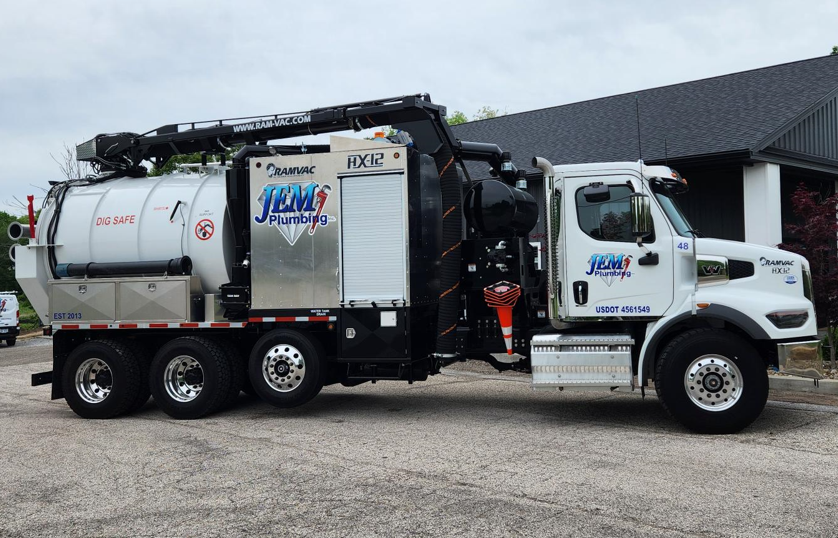
JEM Plumbing operates its own hydro vac equipment, which means we’re not waiting on a subcontractor or adding a third-party cost to your project. When the situation calls for it, we bring it on site ourselves and get to work.
How a Hydro Vac Truck Works
At its core, hydro vac excavation does what a shovel does — moves dirt to expose what’s underground — but in a way that’s far more controlled, far less destructive, and far safer for everyone and everything involved.
Step 1 — High-Pressure Water Breaks Up the Soil A technician uses a handheld wand connected to the truck’s high-pressure water system to spray a concentrated, powerful stream of water directly at the ground. The pressurized water breaks up the soil — whether it’s loose topsoil, compacted clay, gravel, or even frozen ground — and turns it into a liquid slurry. The water does the cutting work that a backhoe bucket or a shovel would otherwise do, but with a precision those tools simply can’t match.
Step 2 — A Powerful Vacuum Removes the Slurry Simultaneously, a large industrial vacuum system — think of it as an enormous wet/dry vac mounted on a truck — pulls the loosened soil slurry up through a hose and into a sealed debris tank on the vehicle. The excavated material doesn’t pile up on your lawn or driveway. It goes directly into the truck, cleanly and continuously, as the digging progresses.
Step 3 — Precise Exposure of What’s Underground As the water and vacuum work together, the excavation area is exposed gradually and exactly. The operator controls the wand with precision, uncovering exactly what needs to be uncovered — a pipe, a utility line, a sewer lateral, a valve — without disturbing anything around it. The result is a clean, smooth-sided hole or trench with clearly exposed infrastructure and undisturbed surrounding ground.
Step 4 — The Debris Is Hauled Away When the debris tank fills up, the material is transported off site for disposal. No slurry pile in your yard, no mud tracked across your driveway, no debris left behind. The job site stays clean throughout the entire process.
The trucks themselves are impressive pieces of equipment. Hydro excavation can dig to depths of 30 to 50 feet depending on soil condition, water pressure, and vacuum power. Powerful hydrovac trucks can also reach areas up to 600 feet away from where the truck is positioned — meaning the truck can stay on the street while the hoses reach deep into a backyard or across a commercial property, minimizing disruption to the surface entirely.
And for Northeast Ohio winters — hydro excavation is effective in cold weather and frozen ground. The heated water used in hydro excavation can effectively break through frozen soil, making it a valuable year-round service.
Why This Matters for Your Property
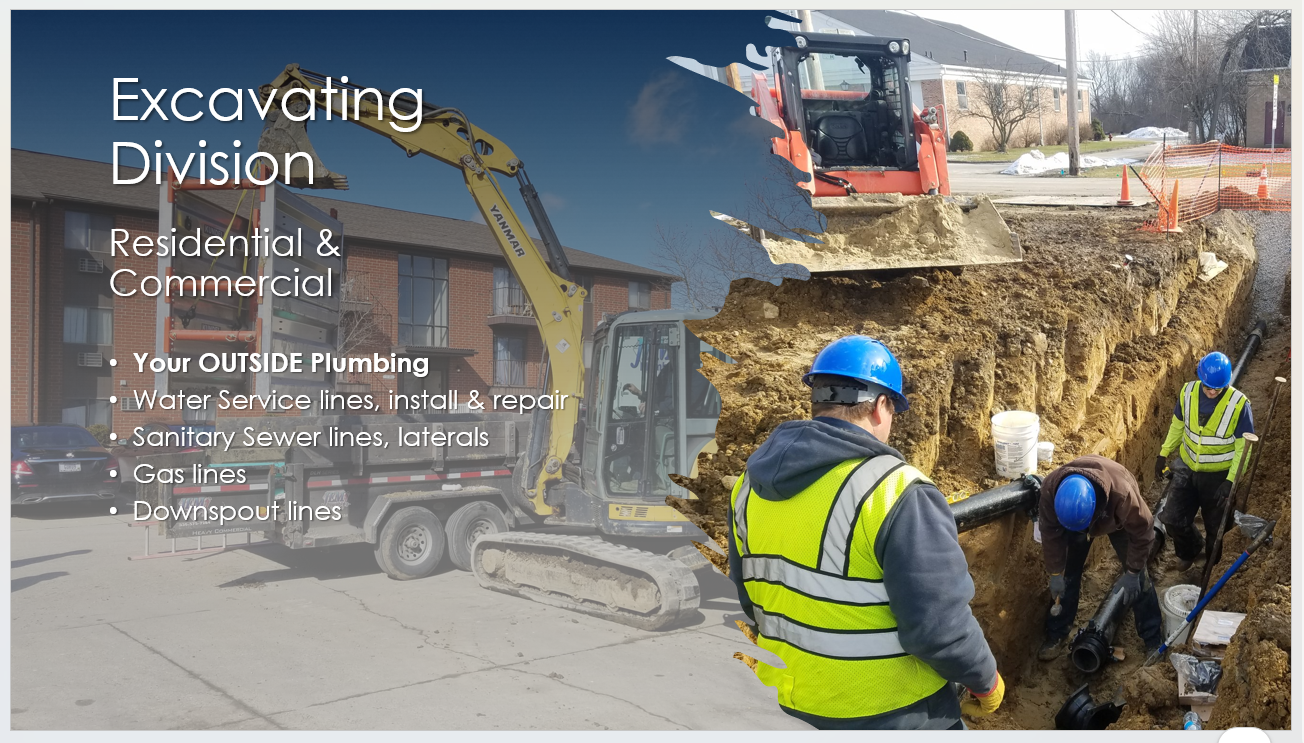
Traditional excavation means backhoes, manual digging, and the inevitable collateral damage that comes with moving large amounts of earth around your property. It means torn-up lawns, broken pavement, damaged landscaping, and disruption that can last long after the actual plumbing work is finished.
Hydro vac excavation means none of that.
Your landscaping survives. Because the process is precise and controlled, plants, shrubs, tree roots, and grass surrounding the work area stay intact. We excavate exactly what needs to be excavated and nothing more.
Your driveway and hardscaping stay in one piece. When underground work is needed near a driveway, patio, or walkway, hydro vac equipment can reach beneath them without cutting or breaking the surface — something a backhoe simply cannot do.
Your underground utilities are protected. Hydro excavation safely exposes buried pipes, making it easier to inspect and access them for repairs or maintenance. This is especially important for fragile or aging infrastructure. The water and vacuum system won’t nick a gas line, slice through a fiber cable, or crack a water main the way metal digging tools can. In an area with congested underground utilities — which describes most developed residential and commercial properties — that’s not a small thing.
The job gets done faster. The excavated material is immediately suctioned into the vacuum system, leaving the area clean and ready for further plumbing work. There’s no waiting for a debris pile to be removed, no secondary cleanup crew needed, no back-and-forth. The excavation and the cleanup happen simultaneously.
The restoration work afterward is minimal. When a backhoe digs a trench, restoring the surface afterward is often a significant project in itself — regrading, reseeding, repaving. When hydro vac completes an excavation, the footprint is clean, precise, and dramatically easier to restore. In many cases, it’s simply a matter of backfilling the exposed area after the plumbing work is complete.
The Safety Advantage
Traditional excavation puts workers in trenches alongside heavy equipment — a genuine safety risk that the industry deals with every day. Hydro vac excavation changes that equation entirely.
With traditional digging methods, you need a person in the trench to guide the equipment. With hydro excavation, both the equipment and workers can be distanced from the excavation site. The operator controls the wand from above ground. The vacuum does the heavy lifting. Nobody is standing in a hole next to a running machine.
For commercial and municipal clients, that reduced risk profile has real implications — fewer liability exposures, safer job sites, and work that meets the highest standards for utility excavation safety.
One Company. One Call. We Bring the Equipment.
A lot of plumbing contractors will tell you they can handle a job and then bring in an outside hydro vac company when the digging starts — adding cost, adding coordination, and adding the potential for delays when schedules don’t line up.
JEM Plumbing owns and operates our own equipment. When a job calls for hydro vac excavation, we bring it ourselves. That means:
- One point of contact for the entire project from excavation through repair and restoration
- Tighter scheduling with no dependency on a third-party crew’s availability
- Direct accountability for every phase of the work
- Lower overall cost without a subcontractor markup built in
It’s the same reason we own our own heavy equipment across the board — because when you control the tools, you control the timeline, the quality, and the outcome.
Is Hydro Vac the Right Choice for Your Project?
In most situations involving underground access near existing utilities, landscaping, or structures — yes, it’s the better method. It’s more precise than traditional digging, safer for buried infrastructure, faster in execution, and dramatically less disruptive to your property.
Not sure if your project is a good fit? Give us a call and describe what you’re dealing with. We’ll tell you straight — whether it’s the right tool for the job, what it would involve, and what you can expect the work site to look like before, during, and after.
Where We Use Hydro Vac Equipment
Residential Applications
- Locating and exposing water service lines for repair or replacement
- Accessing sewer laterals without destroying a lawn or driveway
- Uncovering cleanout ports and valve boxes buried under landscaping
- Exposing septic tank lids and system components
- Digging precise trenches for new water or gas line installation
- Accessing underground pipes in tight spaces near foundations
- Emergency digs when a leak or break needs to be found fast
Commercial & Industrial Applications
- Utility locating and daylighting — safely exposing buried utilities before any other excavation begins
- Sewer and water main repair and replacement in developed areas
- New construction underground utility installation in congested sites
- Catch basin and storm drain excavation and cleaning
- Lift station and pump station access and maintenance
- Trench excavation for commercial gas line installation
- Excavation near existing utilities on active commercial properties
- Municipal infrastructure work requiring minimal surface disruption
About the Author: Heather Mantel

Heather is Vice President at JEM Plumbing, Inc. and has worked alongside husband Jeremy, since the beginning and launch of JEM in 2013. Heather loves meeting new people, and enjoys talking with customers, getting to know Supply Reps, fellow entrepreneurs and being a part of BNI and the Akron/Canton PHCC (Plumbing, Heating Cooling Contractors, Association).